Money that comes from inside the business or from the owner.
These sources do not have a time scale as the finance does not have to be paid back. It could be seen as short term because the money is made quickly but could be seen as long term because the money is never paid back.
Retained Profit Reinvesting the profit made by the business. (No Term)
Allows you to have more money in the business to buy supplies or pay bills. However it means the owners will receive less profit and the money may not be made back. Also the business needs to be running for at least a year.
Owners Funds Owners use there personal savings to set up and invest in the business. (No Term)
It allows the owner to have ownership of the business, which allows them to gain more profit as they own more of the company.However the owner will be left with less money to spend on themselves.
Sale of Assets The business sells owned assets to raise finance. (No Term)
This allows the business to gain money quickly and get rid of unused items that could be taking up space or money to maintain. However you will no longer have these assets and if you are to sell off one of the locations of the business you could have less customers. The business will also have less resources to use.
External Sources of Finance
Money that comes from outside the business or owners. Creates debt.
Bank Loans Money borrowed from a bank for a set rate of finance over a period of time. (Medium/Long Term)
Repayments are over a long period of time and there is a certain amount paid out each time which is good for cash flow. However it can turn out to be expensive and proof of assets is needed.
Family and Friends Money is borrowed from Family and Friends. (Short/Medium/Long Term)
The money may not have to be paid back and there will probably no interest fee. However the people may depend on the business and may interfere and want to help make decisions or have ownership of the business. This could lead to large family arguments.
Overdraft Allows you to use more money than in your bank and become overdrawn. (Short Term)
Allows you to borrow money in the short term so that you can buy quick item such as supplies or pay bills. However it can be expensive due to high interest rates and it could just be cheaper to take out a loan.
Grants The Government gives you money to invest in your business, which can be established or a start-up. The Government usually gives the grant if the business locates in a certain area. (No Term)
The grant does not have to be paid back, which is a big incentive for businesses to set up in a certain area. However not all business are eligible and location is a key factor.
Mortgage Finance used to buy property. However it can also be used to take money out if you want to extend your mortgage but their will be more interest to pay back. (Long Term)
A mortgage allows you to borrow a large amount of money to buy property. However it can be expensive and if payments are not made the property can be repossessed which could end your business.
Share Capital Used in PLCs and LTDs, Share Capital allows businesses to issue shares to raise finance. (No Term)
Share Capital allows you to get investment but could mean you loose control of your business. Also the original owner will make less profit as it will go to the shareholders.
Trade CreditTrade Credit adopts the 'Buy Now, Pay Later.' strategy. It is given by the supplier for 30 days. (Short Term)
No interest is charged and it is good for cash flow. It also allows you to sell the products before you pay for them so that you have money to do so. However it means you are in debt and may stop you getting other external sources of finance. There is also no discount for cash.
Leasing Leasing allows you to rent large items. (Medium Term)
Leasing allows you to use items and not pay a lump sum for them. It is also quite cheap in the short term and allows you to buy new items every few years. However it can get expensive and you have to give the item back although you have paid a lot for it. You are also not responsible for it so if breaks the supplier will fix it for you.
Hire Purchase Hire Purchase allows you to use a item for a period of time and then eventually fully own it. (Short Term)
Hire Purchase allows you to spread the cost and eventually own the item. It is good for cash flow as there is a regular outflow. However there is high interest which can cause it to become expensive and you are responsible for any damage.
Advertisements
Promoting something. e.g. product, business, service, job...
Types of adverts:
TV
Newspapers and Magazines
Public Transport
In Shops
Radio
Mail
Online
Social Media
Market research
Researching the market for your product/service/business to find out about your customers and there needs and wants.
Questionnaires/Surveys
Allows you to see local demand but may not get many opinions. (Primary - done yourself) Internet Research
Allows you to see what other businesses have done but may not be relevant to you. (Secondary - somebody else has done it)
Marketing Mix / 4P's
Product, Price, Place and Promotion.
Product - The features and appearance of a product or service.
Design
Quality
Sizes
Features
Brand
Packaging
Variety
Price - How much customers will pay for a product.
Discounts
Allowance
Payment periods
Credit terms
List price
Place - Where the product is so a customer can get to it.
Transport
Location
Channels
Coverage
Promotion - How customers find out about a product.
Communication
Adverts
PR- Public Relations
Sales promotion
Sales force
Sponsors
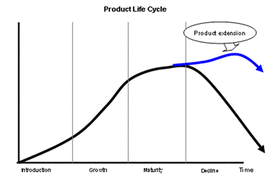
The Product Lifecycle.
Introduction
Building awareness of a product. High cost. Informative promotion. Growth
Increasing Market share. Persuasive promotion. Maturity
The most a product will see. Persuasive promotion. Decline
End of products life. Cheaper cost. Less advertising. Extension
Increasing products life by improving it.
Internal Sources of Finance
Traditional Manufacturer > Wholesaler > Retailer > Customer
This route is used by small shops and allows product to be in a wide range of locations. Also the Retailer will be able to get trade credit from the Wholesaler to purchase the goods. The risk is with the Wholesaler to see the products. However links from Manufacturer to Customer are limited so the product may not be pushed. The process may take a long time and is unsuitable for perishable items. Also each step will want a profit so the customer will pay more for the product.
Modern Manufacturer > Large Retailer > Customer
This route is used by supermarkets and allows large deliveries of the product to be taken by the Manufacturer to one place rather than every store. However large retailers like supermarkets demand reductions so the Manufacturer may make less profit.
Direct Manufacturer > Customer
This route is used by Customers. It allows the Manufacturer to have direct communication with the Customer and can persuade them to buy other products. As this is shorter it cuts out the middle men so the price is cheaper for the customer and the manufacturer can make a bigger profit. However the sales force and delivery can become expensive and 'miss-selling' can happen if commission is given.
Where products are sold:
- Department Stores
- Chains
- Discount Stores
- Superstores
- Supermarkets
- Local Shops
- Internet
- Telephone
- TV
- Catalogue
Cost Plus
Adding all costs then adding a percentage. Easy way to track growth but may overestimate price.
Penetration
Low prices to gain market share. Easy way to gain adoption but may upset customers later on.
Skimming
Reducing prices over time. Can be sold for high prices at intro but may put off customers.
Competitor
Setting price based on competitors. More sales but could loose money.
Psychological
Not breaking price barriers with a .99. Allows you to sell more but make less money.
Loss leader
Sell products at a loss to gain customers but may not recover money.
Discrimination
Sell similar products at a different price to make more revenue but could be seen as unfair.
Destroyer
Lowering prices to remove competitors. More custom but less profit.
Objectives
A Objective is an aim or target that a business works towards.
When choosing the objectives they need to be (SMART) :
Specific
Measurable
Achievable
Realistic
Timed
Growth- How a business expands over time. (through profits and locations.)
Survival- When a business continues to make money in recessions and is still operating when there are large competitors.
Producing a good product- Customers will return for a good product.
Earning a profit- To re-invest into the business or pay owners.
Customer satisfaction- A satisfied customer will return.
Market share- What percentage a company has of the market.
Being ethical- Operating with communities values and traditions.
Being environmental- Not damaging the environment.
Features of a business plan:
Aims
Goals of the business.
Objectives
How the business will get to its aims.
Market environment
How the business market is doing.
Target Market
Who the business is aimed at.
Competition
Who are the main competitors.
Products/Services
What the business does.
Marketing
How the business will promote itself.
Distribution
How the product will get to the customer.
Funding
Where the finance is from.
Forecast
How much revenue will be made.
Resources
What is needed.
Timescale
When certain stages will happen.
Shareholder
A person who owns all or a part of the business.
Stakeholder
A person who has a interest in a business.
Types of Stakeholders:
Owners
Want maximum profit.
Employees
Want their pay and good working conditions.
Customers
Want good products/services.
Local area
Reputation, Land prices.
Government
Want Tax and Law obedience.
Suppliers
Want to make money and sell items.
Conflicts in Stakeholders
Owner V Employee
Employee wants more pay. Owner want to give less.
Owner V Supplier
Owner wants supplies cheaper. Supplier wants more money.
Owner V Community
Community won't want pollution and traffic. Owner won't care as much.
There are 5 main legal structures:
Sole Trader
Partnership
Franchise
Private Limited Company (LTD)
Public Limited Company (PLC)
Sole trader
A sole trader is when the business is ran by one person who owns the business and controls it. They have unlimited liability, so they are responsible for debts. Most finance comes from personal savings and/or loans. Main aims of the business are survival, to make a profit and to provide a good customer service. Examples of this type of business could be your local shop or window cleaners.
Advantages & Disadvantages
Advantages of Sole traders are that they are easy and quick to set up and can be quite cheap. All control and profit is the owners and they can change their working hours or other factors to their needs. However if the owner is ill the business can grind to a a halt and it is hard to get loans.
Extra Fact:
When a business is passed on after the death of a owner it becomes a new business.
Partnership
A partnership is ran and owned by 2-20 partners. They all have a equal share in the company unless there is a DEED OF PARTNERSHIP that states how much each partner owns. The finance comes from each of the partners or from loans. Each of the partners have unlimited liability and are responsible for each others business debts as well as there own. Main business aims are to make a profit and grow.
Advantages & Disadvantages
Advantages of a partnership is that the work is shared and there is more finance and skills available. It is also quite easy to set up. However there could be disagreements which could be disruptive and they each get a smaller profit than if they were to set up alone.
Extra Fact:
If a partner leaves from the company the business will end as the partnership is stopped.
Franchise
A Franchise is where a Franchisor allows a Franchisee to use there brand for a Royalty fee. (Which on average is around 4%.) The Franchisor owns the brand and the Franchisee runs the business. (92% are profitable.) Examples of this business are McDonalds, KFC and Kwik Fit. The prices and supplies are usually controlled by the Franchisor but the Franchisee controls marketing. The Franchisee has unlimited liability so they are responsible for debts. Main aims are to make a profit for both people and the Franchisor will want to expand. Most of the finance comes from personal savings and/or bank loans.
Advantages & Disadvantages
Advantages of franchises are that it allows people start up their own business and use a well-known brand which makes it easier to get more customers and raise finance as banks are more likely to give loans to well-known brands and sometimes the Franchisor gives the Franchisee the equipment. However the Franchisee does not have full control over the business and it can be expensive to set up. Also in most cases you can only buy supplies from the Franchisor who is only interested in their own success and getting the royalty fee.
Limited Company
(LTD - Private Limited Company / PLC - Public Limited Company)
A PLC is a larger version of a LTD. The business is owned by shareholders. In a PLC the shares can be bought and sold freely through the stock market, however in a LTD you can't sell shares freely and you have to be invited in. The company directors run the business and the shareholders vote in decisions. The profit is either re-invested into the business or paid out as a dividend to the shareholders. The owners have limited liability which means that they can lose their share but will not have to give any more money to the company to cover the debts. Every year shareholders meet at a AGM which is Annual General Meeting where shareholders vote, ask questions about the company and review it. The company is ran by a board of directors that make the decisions. Examples of this type of business are Apple, Morrisons and Google.
Advantages & Disadvantages
Advantages of a LTD is that you can get more finance and the people who start the business can keep in control but the public cannot invest, shares can not be sold and legal matters can last a long time. Advantages of a PLC is that you can get high investment returns and each shareholder pays less tax. They also can freely buy and sell shares but there are lots of long legal matters and the owners can loose control. It can also be quite expensive to run but can be very large companies.